Quick answer
Hylase is the trade name for hyaluronidase, an enzyme that dissolves hyaluronic acid-based fillers. It only works on HA fillers, not on Radiesse or Sculptra. The full result shows within 24 to 48 hours, and several sessions are sometimes needed. Abir carries out your consultation herself before every injection treatment.
Not every filler treatment turns out as planned. Sometimes the volume is too much. Sometimes the product has ended up in the wrong place, or shifted over time. Sometimes you have simply changed your mind about how you want to look. Regardless of the reason, there is a solution, and it is called Hylase.
This is something I want to be open about: even the most skilled injectors in the world encounter situations where filler needs to be adjusted or removed. It is not a failure. It is part of the reality of aesthetic medicine. And that is precisely why Hylase is such a valuable tool. It gives us a safety net, an opportunity to correct, adjust and start over.
At Dibélle in Helsingborg, we regularly see clients who need filler removal. Some have been treated by us, others come from other clinics. Everyone is met with the same respect and care. In this guide, I share everything you need to know about Hylase, how it works, what to expect and how the process looks at our clinic. Want to prepare for your visit? Read our preparation guide.
What is Hylase?
Hylase is the trade name for hyaluronidase, an enzyme that breaks down hyaluronic acid. It is not a new invention. Hyaluronidase has been used in medicine since the 1940s, including in eye surgery, wound healing and as an aid to improve the spread of injected medications. In aesthetic medicine, it is used specifically to dissolve hyaluronic acid-based fillers.
The enzyme works by cutting apart the chemical bonds in hyaluronic acid's molecular chains. The result is that the gel-like filler gradually breaks down and is absorbed by the body. The process is controlled, well-established and reverses the effect of the filler without damaging surrounding tissue.[1]
Important to know: Hylase only works on HA fillers
Hylase only dissolves fillers based on hyaluronic acid. This applies to the most common products on the market:
- Juvéderm (Voluma, Volift, Volbella, Volux)
- Restylane (Lyft, Defyne, Refyne, Kysse)
- Stylage (M, L, Special Lips)
- Revolax
Hylase has no effect on fillers that are not hyaluronic acid-based. This means that products such as Radiesse (calcium hydroxylapatite) and Sculptra (poly-L-lactic acid) cannot be dissolved with Hylase. These biostimulators break down naturally in the body over time, but the process cannot be accelerated with enzymes. Read more about these treatments in our guides on Radiesse and Sculptra.
This is one of the reasons why hyaluronic acid-based fillers still dominate the market. The ability to correct and reverse provides an extra layer of safety that neither clients nor injectors want to be without.
When is filler removal needed?
There are several reasons why you may want or need to dissolve filler. None of them are unusual, and none should carry any shame.
Overcorrection
Sometimes there is simply too much. Perhaps a bit extra was added at the last appointment, or you have built up filler over several years and feel that the result has gone from natural to overdone. Particularly in the lips and cheekbones, a gradual build-up can lead to the volume progressively exceeding what you actually want.
Asymmetry
The face is rarely perfectly symmetrical, and sometimes filler amplifies an existing imbalance instead of evening it out. It can be that one side swelled more during the healing process, or that the product was placed slightly unevenly.
Lumps and irregularities
Sometimes filler can clump and form visible or palpable lumps (nodules) under the skin. This can be due to the product's consistency, injection technique or how the body reacts to the filler. Hylase can dissolve these lumps effectively.
Filler migration
Filler can migrate from its original placement over time. This is most commonly seen in the lips, where the product can shift upwards towards the border of the upper lip and create an unnatural profile. Migration can also occur in the tear trough and cheeks.
Dissatisfaction with the result
You did not like it. Full stop. That is a perfectly valid reason, and you do not need to justify it further. Aesthetics is subjective, and the most important thing is that you feel comfortable with how you look.
Vascular compromise (emergency situation)
In rare cases, filler can unintentionally be injected near or into a blood vessel, which can restrict blood flow to the tissue. In these cases, Hylase is an emergency medication that is injected immediately to dissolve the filler and restore blood circulation. All responsible clinics have Hylase available for precisely this situation.
"I want everyone considering filler removal to know that it is completely normal. It is not about something having gone wrong, it is about us having the ability to fine-tune and adjust. Aesthetic medicine is a process, not a one-off event. And Hylase is one of the things that makes that process safe." Abir Mustafa, registered nurse, Dibélle
How does Hylase work?
Hyaluronidase, the active enzyme in Hylase, is a biological catalyst. It specifically breaks down hyaluronic acid's glycosidic bonds, the chemical bridges that hold the gel's structure together. When these bonds are cut, the filler fragments into smaller parts that the body can then absorb and transport away via the lymphatic system.
Timeline
The effect is not immediate, although you can often see some reduction within a few hours. The full result shows within 24 to 48 hours. During that time, the enzyme works continuously to break down the hyaluronic acid.
Are multiple treatments needed?
Sometimes a single session is enough. But depending on how much filler needs to be dissolved, how long it has been in place and which type of product is involved, 2 to 3 treatments with a few weeks between them may be required. Thicker, more cross-linked fillers (such as Juvéderm Volux for the jawline) generally require more Hylase and more sessions than softer products.
We always evaluate the result carefully between each session and adjust the dose. It is better to work gradually and in a controlled manner than to give too much at once.
Want to understand more about different filler types and how they work? Read our complete fillers guide for an in-depth overview.
How the treatment works at Dibélle
Step 1: Consultation
Everything begins with a thorough consultation. We examine the area to be treated, discuss your history (which product was injected, when, how much) and set realistic expectations. If you have been treated at another clinic, we ask you to bring as much information as possible about which products were used.
Step 2: Allergy test
Since hyaluronidase is a biological enzyme, there is a small risk of allergic reaction. We therefore perform a skin prick test on the forearm before the treatment. It takes approximately 20 minutes to evaluate. If no reaction occurs, we proceed.
Step 3: The injection
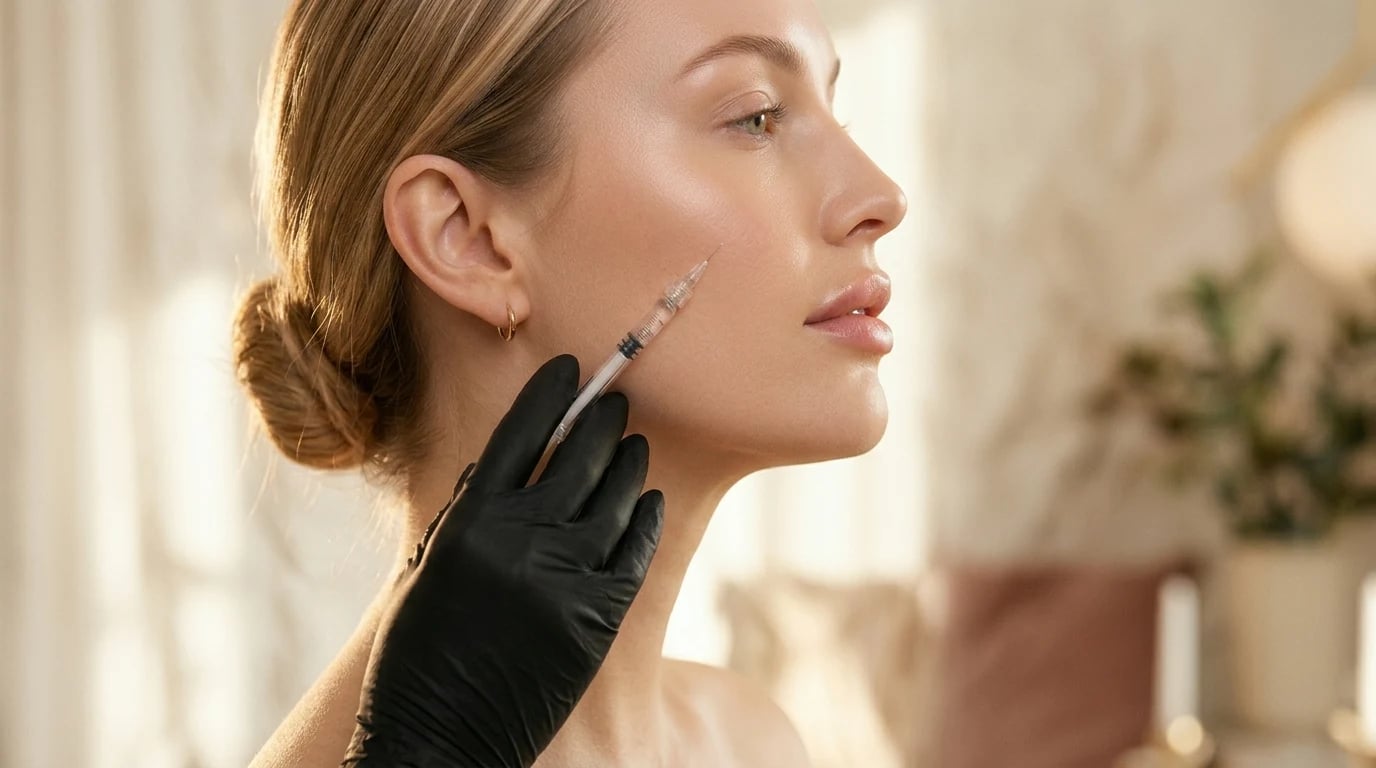
Hylase is injected with a fine needle directly into or near the area where the filler sits. The treatment itself takes 15 to 30 minutes depending on the size of the area. We work methodically and inject in small, controlled doses.
Most people experience a slight prick and a temporary burning sensation that disappears quickly. The area can be numbed with topical cream if you wish, but many find it unnecessary.
Step 4: Massage and observation
After the injection, we gently massage the area to distribute the enzyme evenly. You remain at the clinic for 15 to 20 minutes so that we can observe any immediate reactions.
Step 5: Follow-up
We always book a follow-up after 2 to 3 weeks to evaluate the result. At that point, we determine whether further treatment is needed or if you are ready to move on to a potential new filler treatment.
Which fillers can be dissolved with Hylase?
This is a question we get frequently, and the answer is simple: if your filler is based on hyaluronic acid, it can be dissolved. If it is not, it cannot be dissolved.
Fillers that CAN be dissolved
- Juvéderm (all variants: Voluma, Volift, Volbella, Volux)
- Restylane (all variants: Lyft, Defyne, Refyne, Kysse)
- Stylage (all variants: M, L, Special Lips)
- Revolax (Fine, Deep, Sub-Q)
- Belotero (Soft, Balance, Intense, Volume)
- Teosyal (RHA series)
Fillers that CANNOT be dissolved
These products are not hyaluronic acid-based and are unaffected by Hylase.
| Filler | Base | Breakdown |
|---|---|---|
| Radiesse | Calcium hydroxylapatite | Breaks down naturally over 12 to 18 months |
| Sculptra | Poly-L-lactic acid | Stimulates collagen and breaks down over 2 years |
| Permanent fillers (silicone, PMMA) | – | Cannot be dissolved with any enzyme, requires surgical removal |
If you are unsure about which type of filler you have, we will find out during the consultation. In most cases, you can contact the clinic where you were treated to obtain product information.
Recovery and aftercare
Filler removal with Hylase generally has a short and uncomplicated recovery period, but there are things to keep in mind.
The first 24 to 48 hours
Swelling is common and completely normal. The area may look more swollen before it looks better, that is the enzyme at work. Mild redness and tenderness at the injection sites also occur.
Avoid:
- Intense physical exercise
- Alcohol
- Sauna, steam rooms and extreme heat
- Massaging or pressing the area (unless we have specifically asked you to do so)
Day 2 to 5
The swelling begins to subside. Most people see a clear change by day 2 to 3. Any bruising may persist for up to a week, particularly if the treatment area is sensitive (such as lips or under the eyes).
Day 5 to 14
The result stabilises. By this point, most of the enzyme has done its work and you can assess the result more fairly. Avoid facial treatments, facial massage and strong skincare products until the two-week follow-up.
Aftercare tips in brief
- SPF 50+ daily for at least two weeks, this is non-negotiable
- Avoid retinol and strong acids for 48 hours after treatment
- Drink plenty of water to support the body's healing process
- Sleep with your head slightly elevated on treatment night to minimise swelling
- Avoid swimming pools and saunas for at least 48 hours
- Contact us if the swelling has not begun to subside after 48 hours or if you experience unusual symptoms
Can I get new filler after Hylase?
Yes, and it is actually quite common. Many of our clients use Hylase as a "reset", an opportunity to start over with a clean canvas and achieve a better result next time.
Our recommendation is to wait 2 to 4 weeks after filler removal before new filler is injected. This gives the tissue time to recover fully and ensures that all excess hyaluronidase has broken down.
Many people find that the second result is actually better than the first. When filler is built up layer by layer over several years, proportions can gradually shift. By dissolving everything and starting over from a baseline, we can work more precisely with volume and placement.
If you are thinking about what to do after your Hylase treatment, we recommend exploring our guides on lip augmentation with fillers and our complete fillers guide to get an overview of your options.
Frequently asked questions about filler removal
Does Hylase hurt?
Most people describe the treatment as a brief prick followed by a temporary burning sensation that lasts a few seconds. The discomfort is mild and short-lived. We offer numbing cream for those who are extra sensitive, but many choose to manage without it. Compared to the filler injection itself, most people find the Hylase treatment more comfortable.
Can Hylase dissolve too much?
Yes, it is theoretically possible that Hylase dissolves more hyaluronic acid than intended, including some of the skin's own natural hyaluronic acid. This is why we always work with controlled doses and gradual treatments. The body produces new hyaluronic acid continuously, so any loss of natural hyaluronic acid is restored within a few weeks. This is another reason why we prefer to work conservatively and evaluate between sessions.
How do I know if my filler is hyaluronic acid?
The easiest way is to contact the clinic where you were treated and ask for product information. The vast majority of fillers injected in Sweden today are hyaluronic acid-based (Juvéderm, Restylane, Stylage and others). If you have had Radiesse or Sculptra, which are biostimulators, these cannot be dissolved with Hylase. During the consultation at Dibélle, we help you determine which product is involved.
Is Hylase covered by insurance?
Filler removal is an aesthetic treatment and is not covered by Swedish health insurance. The exception is if the treatment is performed as a medical emergency measure in the case of vascular compromise. During your consultation in Helsingborg, we provide a clear price with no hidden costs.
Can I get Hylase if I was treated at another clinic?
Absolutely. We regularly see clients who have been treated at other clinics. The only thing we need is information about which product was used and approximately how much. If you do not have these details, we make an assessment based on clinical examination.
Myths and facts about filler removal
"Hylase is dangerous"
Fact: Hyaluronidase is a biological enzyme that has been used in medicine for over 80 years. It has a well-documented safety profile, and serious side effects are very rare. The most common reaction is temporary swelling and redness at the injection site. Allergic reactions occur but are uncommon, and we always perform an allergy test before treatment.
"You can never get filler again after Hylase"
Fact: Incorrect. You can get new filler after 2 to 4 weeks. Hylase breaks down the existing filler but does not affect the skin's ability to receive new treatment. Many of our clients at Dibélle choose to get filler after Hylase and are very satisfied with the renewed result.
"The filler disappears immediately"
Fact: The process takes time. Although some reduction may be noticeable within hours, it takes 24 to 48 hours before Hylase has done its full work. During that period, the area may look swollen, which can be confusing. We always ask our clients to be patient and wait at least 48 hours before assessing the result.
"You can just massage filler away"
Fact: Massage cannot dissolve filler. Hyaluronic acid-based fillers are gel-formulated and designed to sit stably in the tissue. Intense massage can at best shift the product slightly, but it does not disappear. To actually remove filler, hyaluronidase is needed. If you experience lumps or irregularities, always contact your injector instead of massaging on your own.
"Hylase causes permanent side effects"
Fact: Hyaluronidase is broken down by the body within a few days of injection. The enzyme has no long-lasting effect on the tissue and causes no permanent changes. The only lasting effect is that the injected filler has been dissolved, exactly as intended. The body continues to produce its own hyaluronic acid as normal.
Why choose Dibélle in Helsingborg?
Filler removal requires precision, experience and, perhaps most importantly, empathy. Most people seeking Hylase treatment have a story behind them. Perhaps they are worried, disappointed or frustrated. It is our job to meet them with calm, professionalism and respect.
At Dibélle in Helsingborg, you meet Abir Mustafa, registered nurse with experience in aesthetic medicine since 2011 and more than 10,000 treatments performed. That experience makes a difference, not just in injection technique but in assessing how much Hylase is needed, where it should be placed and how the result will develop over time.
We regularly see clients who have been treated at other clinics and need correction. This means we have broad experience in handling different products, techniques and complications.
With 4.9 out of 5 based on over 1,225 reviews on Bokadirekt and 4.9 on Google based on 1,425 reviews, we know that the trust our clients give us has been earned through consistency, quality and genuine care.
How it works
- 1
Book a free consultation
- 2
Bibbi assesses what suits you
- 3
Treatment only if it's right for you
Ready to take the next step?
Book your consultationYour next step
Considering filler removal? The first step is a free consultation at Dibélle in Helsingborg. We listen to your story, examine the area and create a plan that suits your specific situation. No pressure, no judgement.
Book easily via Bokadirekt, or contact us directly if you have questions. See all our filler treatments and prices for a complete overview.
With care for your skin, Abir Mustafa, Dibélle, Helsingborg
Sources
- 1.Swedish Medical Products Agency: safety information for injection treatments · Läkemedelsverket (2024) lakemedelsverket.se ↩
- 2.Act (2021:363) on aesthetic surgical procedures and injection treatments · Sveriges Riksdag (2021) riksdagen.se ↩